
The lower abdominals represent one of the most misunderstood regions in fitness. Countless people perform hundreds of crunches hoping to develop lower ab definition, only to see minimal results. The problem isn’t effort-it’s exercise selection and understanding the anatomy involved.
Developing the lower abs is essential for achieving v-cut abs and overall core aesthetics. But it requires specific exercises that target this region effectively, combined with the body composition necessary to reveal the underlying muscle development.
Understanding Lower Ab Anatomy
Technically, there isn’t a separate “lower ab” muscle. The rectus abdominis is one continuous muscle running from your sternum to your pelvis. However, the lower portion of this muscle can be preferentially recruited through specific movement patterns.
The key lies in understanding spinal flexion versus posterior pelvic tilt. Traditional crunches create spinal flexion-your spine curls forward, bringing your ribcage toward your pelvis. This predominantly recruits the upper portions of the rectus abdominis.
Lower ab exercises reverse this pattern. Instead of bringing your upper body toward your lower body, you bring your lower body toward your upper body through posterior pelvic tilt-rolling your pelvis backward and up.
The Best Lower Ab Exercises
Reverse Crunches
The foundation of lower ab training, reverse crunches specifically target the lower rectus abdominis when performed correctly. Lie on your back with hands at your sides or under your lower back for support. Bend your knees and lift your feet off the ground.
The movement isn’t simply bringing your knees toward your chest-that’s hip flexion. Instead, focus on rolling your pelvis backward, lifting your hips off the ground slightly. Your lower back should press firmly into the floor as your pelvis tilts posteriorly.
Perform 3 sets of 15-20 controlled reps, emphasizing the pelvic tilt rather than momentum.
Lying Leg Raises
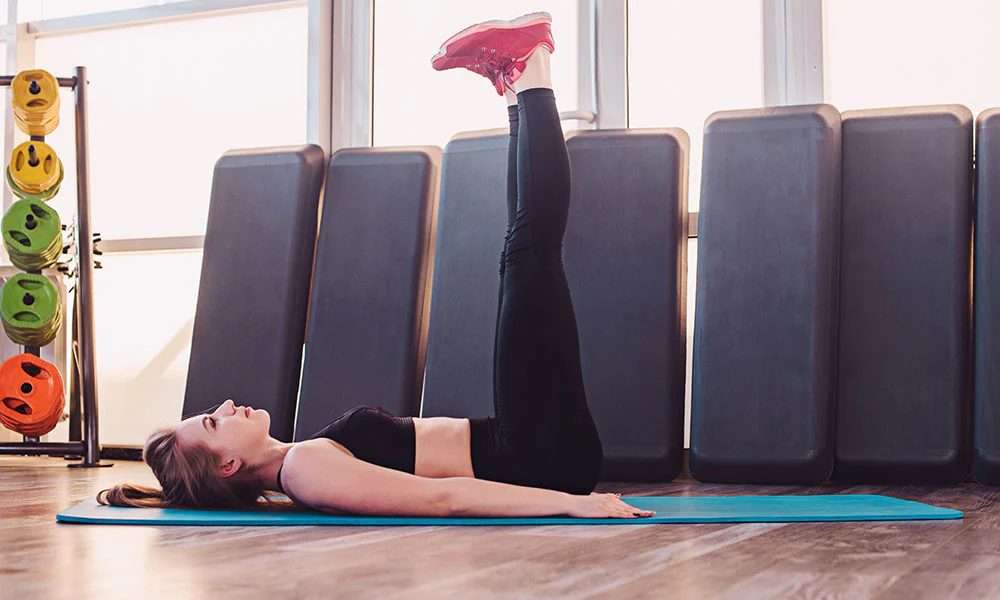
Lie flat on your back with legs extended. Place your hands under your lower back or grip something behind your head for stability. Keeping your legs straight (or slightly bent if hip flexor tightness limits range of motion), raise them until they’re perpendicular to the floor.
The critical technique point: lower your legs only as far as you can while maintaining lower back contact with the floor. The moment your back starts to arch, you’ve exceeded your core strength and hip flexors have taken over.
Start with 3 sets of 8-12 reps, focusing on controlled lowering rather than leg height.
Hanging Knee Raises
Hang from a pull-up bar with arms fully extended. Raise your knees toward your chest, but don’t stop there-continue tilting your pelvis until your knees pass parallel to the floor and your hips curl slightly forward.
This posterior pelvic tilt at the top of the movement is what separates effective hanging knee raises from mere hip flexion. Without it, your hip flexors do most of the work.
Perform 3 sets of 10-15 reps with proper pelvic tilt on each rep.
Dead Bug
While not a traditional “lower ab exercise,” the dead bug develops the anti-extension capacity that keeps your lower abs engaged during other movements. Lie on your back with arms extended toward the ceiling and knees bent at 90 degrees.
Slowly lower one arm behind your head while extending the opposite leg toward the floor. The challenge is maintaining a flat lower back throughout-your lower abs must work constantly to prevent arching.
Perform 3 sets of 10 reps per side, focusing on perfect spinal position rather than speed.
Ab Wheel Rollouts
Starting on your knees, grip the ab wheel and roll forward slowly. Your lower abs must work intensely to prevent your lower back from arching as your body extends. Roll out only as far as you can while maintaining a flat or slightly rounded lower back.
The eccentric (lowering) phase is where the lower abs work hardest. Control the descent rather than dropping forward and muscling your way back up.
Start with 3 sets of 5-8 reps, adding range of motion as strength improves.
Common Mistakes That Limit Progress
Using Momentum
Swinging through exercises transfers work away from the abs to hip flexors and momentum. Every rep should be controlled, especially the lowering phase. If you can’t control a movement slowly, reduce the difficulty or range of motion.
Forgetting the Pelvic Tilt
The defining characteristic of effective lower ab exercises is posterior pelvic tilt. Without this element, you’re primarily training hip flexors. On every rep, consciously think about tilting your pelvis backward and pressing your lower back into the floor (for floor exercises) or rounding slightly at the hips (for hanging exercises).
Holding Your Breath
Proper breathing enhances core activation. Exhale during the contraction phase of each exercise-this activates the transversus abdominis and supports the movement. Holding your breath creates internal pressure that can feel like strength but actually reduces muscle activation.
Training Too Frequently
Abs are muscles that need recovery like any other. Daily ab training doesn’t produce faster results-it produces incomplete recovery and limited progress. Train abs 3-4 times per week maximum, allowing at least 48 hours between dedicated sessions.
Programming for Lower Ab Development
Effective lower ab training follows progressive overload principles, just like any other muscle group. Here’s a sample weekly program:
Session 1 (Monday):
- Reverse Crunches: 3 x 20
- Dead Bug: 3 x 10 per side
- Plank: 3 x 45 seconds
Session 2 (Wednesday):
- Hanging Knee Raises: 3 x 12
- Lying Leg Raises: 3 x 10
- Ab Wheel Rollouts: 3 x 8
Session 3 (Friday):
- Reverse Crunches (with 3-second hold at top): 3 x 15
- Dead Bug with Resistance Band: 3 x 8 per side
- Hanging Knee Raise with Rotation: 3 x 8 per side
The Nutrition Component
No amount of lower ab training reveals definition if body fat is too high. For most people, lower ab definition becomes visible somewhere between 10-15% body fat for men and 17-22% for women.
The lower abdominal region is typically the last place fat leaves and the first place it returns. This isn’t a personal failing-it’s biology. Fat cells in this area have more alpha-2 receptors (which inhibit fat release) and fewer beta receptors (which promote fat release) compared to other body regions.
Achieving the necessary body fat levels requires a sustained caloric deficit. A moderate deficit of 300-500 calories below maintenance typically produces the best results-aggressive enough to produce fat loss, but not so severe that muscle is sacrificed.
Patience and Realistic Timelines
Lower ab development doesn’t happen in weeks-it happens over months. The muscle building component requires progressive overload over time. The fat loss component requires sustained caloric deficit.
Expect visible lower ab definition to emerge after 8-16 weeks of consistent training and nutrition, depending on your starting point. Those beginning with higher body fat percentages will need longer timelines.
Progress photos taken monthly will reveal changes you can’t see day-to-day. Trust the process, maintain consistency, and the results will come.
Conclusion
Effective lower ab training requires exercises that emphasize posterior pelvic tilt rather than simple hip flexion. Reverse crunches, hanging knee raises with proper technique, lying leg raises, dead bugs, and ab wheel rollouts all target this region when performed correctly.
Combine targeted training with appropriate nutrition for your body composition goals. The lower abs respond to the same principles as any other muscle-progressive overload, adequate recovery, and sufficient protein intake.
Be patient with the process. Lower ab definition represents the culmination of consistent training and disciplined nutrition over months, not days. The results are worth the effort.
